
Poetry X Hunger
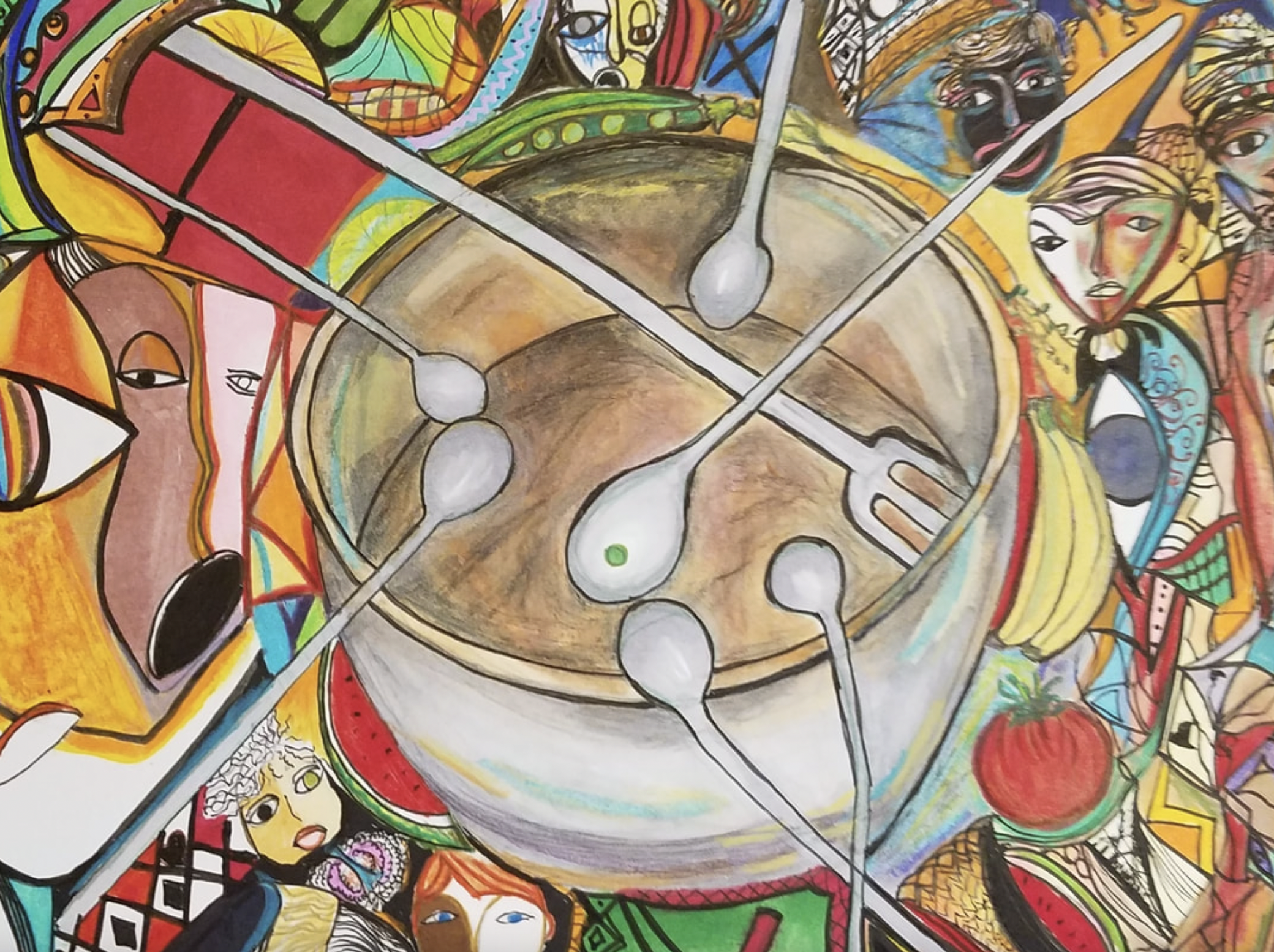
In 2025 ARTS By The People became a partner organization with Poetry X Hunger in Maryland bringing a world of poets and their poems to the anti-hunger cause. This year ARTS By The People is using poetry to raise awareness and compassion about food insecurity in America in general and New Jersey specifically. Our four Poets-In-Residence met during the month of September and October to share stories, visit and volunteer at Food Pantries and write poems about what they saw. The following authors are featured: Veronique Manfredini, Susanna Rich, Gregg Yupanki Bautista, and Nancy Lubarsky. Artwork By Diane Wilbon Parks
Veronique Manfredini (she/her) has a Master's in English from Monmouth University where she is the recipient of the Creative Writing Award in Poetry for Spring 2024. She is the Founding Editor of The Honey Pot Literary and her writing appears or is forthcoming in the Monmouth Review, the Mood Reader Anthology, and Collage Magazine. Veronique hails from Italy and is passionate about incorporating her hometown and language into her writing. She is currently crafting a fantasy-mystery novel set in Florence, Italy, and curating a collection of poems surrounding food and memory.
Roaches
I watch them—hungry, starving,
desperately waiting—as lines form
on their foreheads. Sweat drips, frosts over.
Decisions, decisions.
How many of their own decisions
brought them here; gaunt, in line?
And they just keep coming back for more.
How many of mine brought them to stand
alone, with others, hands outstretched, in search
of a morsel? Shame and fear of not knowing
where their next meal will come from.
How many times have I sent the plagues
but those roaches will not die.
How many times have I cut the funds
but they just keep coming back for more.
Community is not part of America—
it’s a self-absorbed being.
Community does not belong here.
I’ll stomp them out, get rid of them all.
They don’t belong, but they just won’t die.
They just keep coming back for more.
Garden State
Food deserts starve for
affordable nutrition in the Garden—
State of disarray, dust grows
weeds in the concrete smoke jungle.
They forget even when packed—
thin sliced deli meat on a thick sandwich—
the chronic disease isn’t just a
starvation of community and connection.
Food pantries cannot satiate
the needs that stem from a scarce
support system—snap away access—
people refuse to see the truth.
You are what you eat,
but if I have nothing,
who am I?
In Your Fridge
You water yourself—fill
yourself to the brim,
to avoid the growling anger
beneath your ribs.
One apple a day, they say,
so you crunch on
sweet, savory, sharp,
wishing it was a slice
of your mama’s pie—
Instead—
you continue to drown yourself
in a glass, keeping the beast sated
until that number is reached—
desperate for a sense of
achievement.
Others beg
for what you let rot.
Susanna Rich, author of SHOUT! Poetry for Suffrage, writes on historical and political topics, and is a frequent contributor to Sensations Magazine, most recently to its issue on “100 Years of Gay Rights.” With over a thousand publication and performance credits, including five poetry collections, she is a Fulbright Fellow in Creative Writing and an Emmy Award nominee. Susanna is Distinguished Professor Emerita at Kean University, where she proudly served a diverse community of students, who were often the first to have a college education. As a child born to immigrant parents, Susanna knows, from experience, the sacrifices a family must make in the struggle to have enough to eat. She volunteers at Nourish NJ and is a frequent contributor to World Central Kitchen.
We, the Peoples of the Land
gave you fur—beaver, bear, racoon—
you gave us blankets laced
with disease.
Our grapes, rye, currants, sarsaparilla
you turn into hard spirits
to drug us.
We loaned you land you never
return but take the rest.
We gave you the Three Sisters—
corn, beans, squash—
taught you to plant them
with fish heads—
your sugars bloat our bodies,
squeeze our hearts,
so we know, now, like you,
the scourge of never-enough.
We honored the bison, the fish, the deer—
you murder them.
Our clean air you poison
with coal breath and gas.
We taught you to bathe in clear waters—
you pollute it with waste.
We showed you paths—
you blaze, still, The Trail of Tears.
We kept you warm in winters—
you chain our wrists.
We gave you The Four Medicines—
tobacco, cedar, sage, sweetgrass.
We gave you willow for your pain,
witch hazel for your wounds.
You murder, pillage, rape
us through time—
imprison us in wastelands,
starve us, deny our dance
with rain, eagles, wolves,
our ghosts—life-giving stories
around the fire, our burial grounds,
our names, our tongues.
We, the Peoples of the Land—
were your dreamcatchers—
you shred ours apart.
We fed and welcomed you,
you starve and exile us.
Lincoln had 38 Dakota massacred—
the last mass execution in your history.
He proclaimed Thanksgiving
a national holiday as if
gorging, shopping yourselves dizzy
makes amends, “improve relations” with us.
So, we give you this last walking stick,
this broken pot, this tattered basket,
this totem, this potlatch of warning—
you will destroy yourselves
and each other.
The earth, the skies, the waters,
and the fires will give us back
to ourselves.
Mississippi Shelf Life
Here in the Delta, semis won’t come
with something fresh to eat—
no profit for the drive out
to Mom-and-Pops in the boonies—
so, we have dragons in our bellies,
growling with beef jerky,
Pringles, expired Cheetos—
big companies know
salt and fat just make the dragon
want more salt and fat,
and after the need for Little Debbies
or the dragon won’t shut up.
And don’t laugh at us—
looking fat doesn’t mean
you have enough.
Hunger goes deeper
than blubber on bones.
Like I said, our bellies bloat
with the dragon of hunger,
its hoard of backed-up Wonderbread,
and Mac and Cheese grumbling,
twisting around, shooting
flames into our gullets,
knives out of our butts.
It costs, too, all that stuff
shrink-wrapped in plastic
to last in this food swamp—
the crap waits us out forever.
Money goes. Nothing left
for a car. Hell, even if we had one,
no gas to go the miles
to the nearest super—
lettuce, fresh meat, milk—
and the take-back at check-out
for money to get home.
And the dragon keeps clawing,
its eyes knocking from inside our eyes,
maws jamming open our throats,
blowing all that cuss out of our mouths—
hating, yelling, wanting
anyone, anything to take us
off the back shelves of America,
make it stop.
Gregg Yupanki Bautista is a NJ poet, artist, and musician born and raised in the US to Peruvian immigrants. He is the author of the illustrated chapbook Un Lugar Lejos: Valleys (Echo Thread Books, 2024) and releases music under the name Yupanki. He hosts a monthly poetry open mic series in Hopewell, NJ called Poets & Storytellers Open, and runs Echo Thread Books, an independent literary press advocating for and publishing BIPOC writers. Some of Gregg’s poems can be found in The Red Wheelbarrow 18 and in BY THE WAYE No. 2. He is currently working towards the next installment of Un Lugar Lejos, as well as a full length collection of poems.
Brothers
Brother goes in search of food. Brother reads
all the labels. Brother tells our stories with each item
he picks up. Not for sympathy, but because he wishes
we were there. He wants everyone to know us, too.
Brother fills bags and bags with our favorites,
making sure to still get what will keep us strong.
Brother doubles back because he doesn't want to forget
about mom, who works hard to take care of everyone.
Mom never gets to rest, he says.
Dad is smiling, frown lines reconfiguring
to soft crow’s feet while watching brother radiate joy.
The last thing brother picks is a treat for himself and dad.
He reads the label and frowns himself. Does not put it in the bags,
says how little brother is allergic to an ingredient, instead
tucks it under his arm and says to dad,
we’ll have to make sure we only eat this outside,
we need to keep little brother safe. But I sure think
everyone will love all this food we picked.
As he gets in the car, brother wonders what we’ll make first.
Feeling My Name
- after Patricia Smith “Their Savior Was Me”
Here, everything that eats
knows my name, my petulance,
the arrogance shared with my siblings.
With incisors around abdomens, I scar memories,
no mercy granted. Yes, my touch wields
a rampant force when left to linger–unfeal
to ideologies, only to those who let me do my work. I
am unmoved by prayer
or parables of multiplying fish.
I hear daily pleas, weekly ceremonies
to banish me, while many of those same voices
look away when they see my work.
I don’t yield, I watch
as one’s survival is ruled immoral.
In my presence, they must will themselves asleep
as they console themselves with thinking suffering is fortitude.
Isn't that the American Dream? Their voices
beg for salvation through salivation from smells, thinking
just. one. bite.
But I am the wolf here, and they will feel my name.
How Many Birds (Song)
New wings that can fly the fledgelings home cut
through air that must be breathed, must be escaped.
Skylines are pierced by modernity, birds
move among sun scorched fields of steel, a fate
dealt to them in crumbling concrete. Empire
breathes down the backs of the hungry, testing
how long one survives a project designed
to keep fading eyes scaled and worn hands skinned,
too tired to cultivate plumed roots of wings,
roots where caretakers of a quiet earth
sing us an aeolian melody
of sustenance. Some have searched, but our earth
is the only one that knows this song, still
holds ancient language encouraging life.
How Many Birds (Memory)
An ancient language encouraging life
Does not govern machineries built to burn,
Instead colors the air with syllables
Unlocking memories stored deeper
Than skin. Memories that can’t be policed
When sown in fields of possibility.
Even when displaced by settlers, bonds
To land are unbroken, recorded by
Three Sisters, river, and game.
The water, which now continues rising,
Reminds us of the weight of the sky, how
The birds move, weightless. Born to move freely.
Nancy Lubarsky, a retired NJ school superintendent, holds a doctorate in English Education. She has been published in various journals including Exit 13, Lips, Tiferet, Poetic, Stillwater Review and Paterson Literary Review. Nancy is the author of three books: Tattoos (Finishing Line), The Only Proof (Kelsay Press), and her latest book, Truth to the Rumors (Kelsay Press), a finalist for the 2023 Laura Boss Narrative Poetry Award. Her poetry/film collaboration, The Mess (with Sophia Cansalvo) won first place this year in the Moving Words Showcase sponsored by Arts by the People.A lifelong New Jerseyan, Nancy lives in Cranford with her husband and dog, Penny.
New York City, 10 pm
Wall Street is silent, shadowed, as we
drive up behind the “hunger” truck.
The business bustle, the high financiers
and their teams are gone—maybe they’re a
few blocks away finishing drinks and dinner.
The truck is stacked with sandwiches we
made hours before. This is the monthly run.
My husband and I, our kids, are invited guests—
volunteers, witnesses on this journey that began
from my friend’s church in Summit. We bring
not only food, but other wish-list items—soap,
toothpaste, blankets, sweaters. Everything’s
labeled with names and requests. We pull up
to the Manhattan Bridge underpass. It seems
deserted. But slowly figures come into view.
Some huddle around garbage bin fires in filthy,
torn clothes. One woman screams at a hydrant.
Others appear confused, as if they took a
wrong turn. As they slowly edge forward, we
are fearful. Something smells so foul, we cover
our mouths, pretend to sneeze. We are strangers,
but the two men in the truck know many. They
chitchat, use nicknames. We hand out the
sandwiches and hot soup. They toss out the
labeled packages. Soon, the group disperses.
We get ready for the next stop. As the truck
starts up, a man in a shirt and tie, a bit rumpled,
emerges from his car, steps forward. Do you have
any shampoo? They search in the back, find a
small bottle. He thanks them, returns to his car.
Contactless Delivery
She waits behind the door.
We know that. She’s on our list.
It’s early. We just called to say
we are near. She lives alone at the
Royal Motel on Route 1, Room 7.
Our instructions say, Just leave the
bags—stay safe, but we decide
to mask up, knock and wait.
For almost a year we were also
behind a door. We just retired. Our
kids were scared. They told us—Stop
the help, stay inside, don’t risk your
lives. The disease is everywhere. But
we depended on deliveries—other
people who had to leave their homes
to earn a living, who left groceries
on our porch for us to retrieve and
scrub and freeze. We had our family
and enough resources to wait it out.
Was delivery risky? We didn’t think
so. We assured the kids there would
be no contact, no touching, no
exchange of breath. To the right of
her door is a mound of recyclables,
a tent, a bicycle, a beach chair. We
knock again. The door clicks open.
She mumbles something hard to hear.
We glimpse her flowered dress, hand
her the two bags. I try to shake her
hand but she closes the door.
No Line
The crunch of onion peels under
my feet hints at one item that will
fill plastic bags this morning. The
volunteer before me has restocked
the baskets from huge mesh sacks—
the discards of major food chains.
The marker board lists three onions,
two potatoes, one bag of carrots.
There are a few extra apples for the
lucky ones. I judge which bruised
items are still worthy. When no one’s
looking, I slip extra into the bags. At
the next table other volunteers sort
boxed cereal, bagged beans, canned
pears. Often, when I arrive the regulars
are outside, waiting. Especially at the
end of the month when SNAP benefits
run out. Usually, the line snakes out
across the parking lot to the main
avenue. I’m in the back. Sometimes
I forget who’s out there. I don’t get
to check names, listen to stories or
excuses. I don’t talk to their children
who help interpret. Today, I notice
the empty parking lot outside. The
first few in line appear furtive, fearful.
Then I see the sign on the wall that
says who to call if ICE appears.